


Many in the Netherlands view Zwarte Piet (Black Pete) as an innocent addition to the Dutch holiday season. But for others, the figure is deeply offensive and represents a system of inherent racism that parades under “tradition.”
Every year, debates circle around the contentious topic, regarding whether the blackface Zwarte Piet should be allowed in public festivities.
These emotionally charged arguments have led to protests, riots, threats, and even violence — but they’ve also led to some gradual change.
Expats and tourists in the Netherlands are often mystified by the ordeal. If you’ve just walked into the conversation, you may be wondering why everyone is shouting.
So here’s some background on the Zwarte Piet tradition, what both sides have to say about it, and how public opinion is changing over time.
Got an opinion on Zwarte Piet? Make sure to vote in our poll at the end!

No time? Jump quickly to the section that takes your fancy:
Who is Zwarte Piet?
Zwarte Piet plays an integral part in a beloved Dutch celebration. Every November, the Sinterklaas holiday marks the arrival of the Sint (Saint) in the Netherlands.
He comes by boat, supposedly from Spain, accompanied by his helpers, the Zwarte Pieten.
Parades and festivities celebrate Sinterklaas’s entrance all over the country. In these celebrations, Sinterklaas is the stoic hero, and Zwarte Piet is his (controversial) helper.
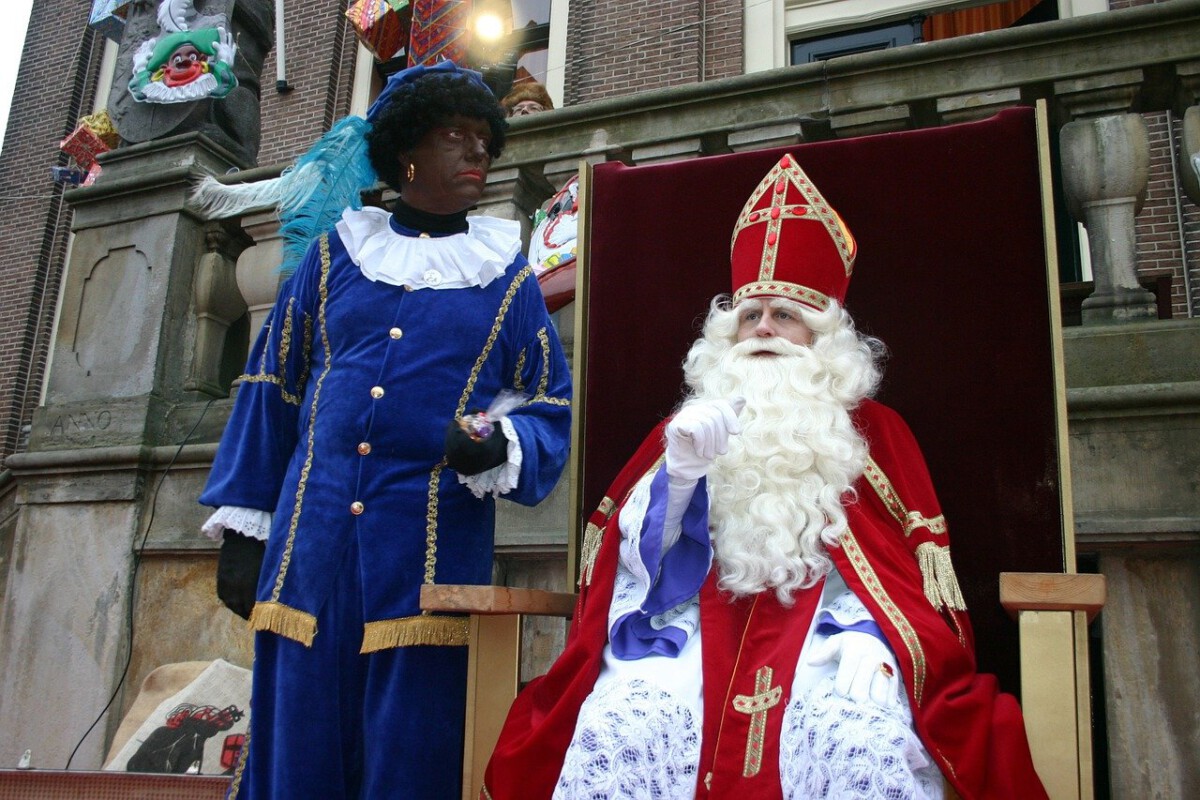
Traditionally, Dutch people portray the character in full blackface makeup, tossing candy and gifts to children.
The character’s original costume comes complete with an afro wig, red lips, and hoop earrings. However, in modern portrayals of the character, some accessories and makeup may be toned down.
History of Zwarte Piet and the blackface tradition
Zwarte Piet’s history is cloudy. People often disagree about when and how the character originated, disputing even historically sound evidence. Sinterklaas, or Saint Nicholas, has clearer roots that can be traced back as far as the Middle Ages.

Throughout the years, tales of Sinterklaas have always included a helper of some kind — be it a chained demon of yesteryear, or Zwarte Piet, the prancing page of modern-day.
The earliest written evidence of Zwarte Piet is found in a 1850s children’s book written by Amsterdam schoolteacher Jan Schenkman. In the book, Zwarte Piet is Sinterklaas’s dark-skinned helper, referred to only as “the servant”.
In the illustrations, he appears in colourful clothing reminiscent of a page. Historians tend to agree that the character is linked to slavery, as the page boys of this era did not work by choice or receive wages.
Changes to Zwarte Piet over time
The character has changed quite a bit since 1850. Originally seen as an assistant to the stern and punishing Sinterklaas, around 1890, the roles reversed.
Sinterklaas softened, and Zwarte Piet became the scary character who would rattle his chains and threaten children with his roe (a switch made of bundled sticks).
Zwarte Piet’s role in the Sinterklaas celebrations has evolved over time as well. Once the sole punisher, by the late 1960s, the character had become more of a friend to children, and the number of Pieten at holiday events had multiplied.

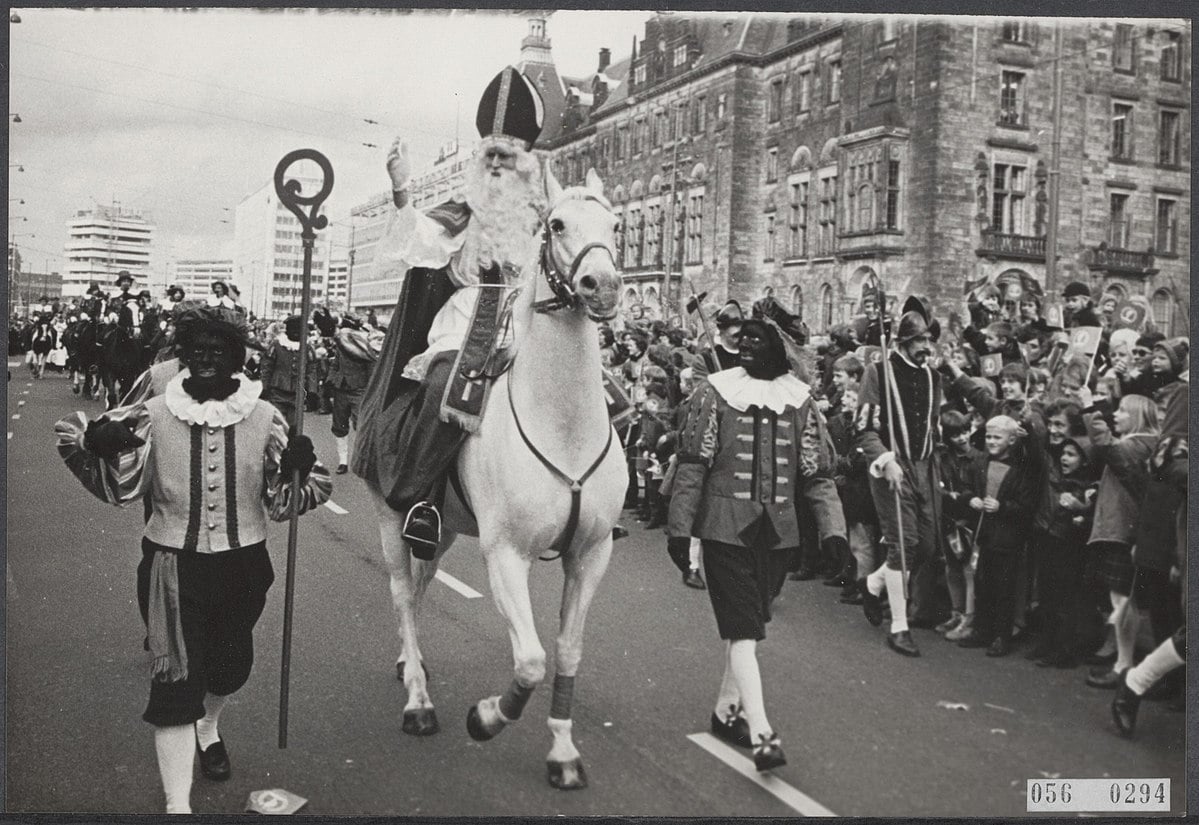
Since then, and up until the last decade or so (when public disapproval was amplified), the Zwarte Pieten have been the highlight of the annual parades.
They bring gifts and treats for good children, while naughty kids are only playfully warned they’ll be whipped and taken away to Spain in one of Zwarte Piet’s burlap sacks.
The Zwarte Piet debate
If this description of Zwarte Piet has you raising an eyebrow or two, you’re not alone. Zwarte Piet has attracted criticism nationally and internationally for years now.
Blackface, even as a form of theatrical makeup, is insulting and dehumanising toward people of colour. Forget the questionable history and dimwitted portrayal of the character; the mere appearance of Zwarte Piet raises alarm bells for many onlookers.
Pro-Zwarte Piet: the traditionalists’ argument
Many traditionalists argue that the character’s appearance is part of a harmless tradition and is not tied to racism in any way. They believe in a different version of history wherein Zwarte Piet was more of a noble servant, and they view the black makeup as simply an old Dutch tradition.
Other Zwarte Piet supporters are convinced the character gets a black face from coming down the chimney. (An idea that leaves out an explanation for the exaggerated lips, afro, and other accessories, however.)
Die-hard Zwarte Piet proponents fight for their right to uphold the character’s full costume as an important part of Dutch culture. They fear that outsiders will strip them of their cultural identity because they don’t understand it.
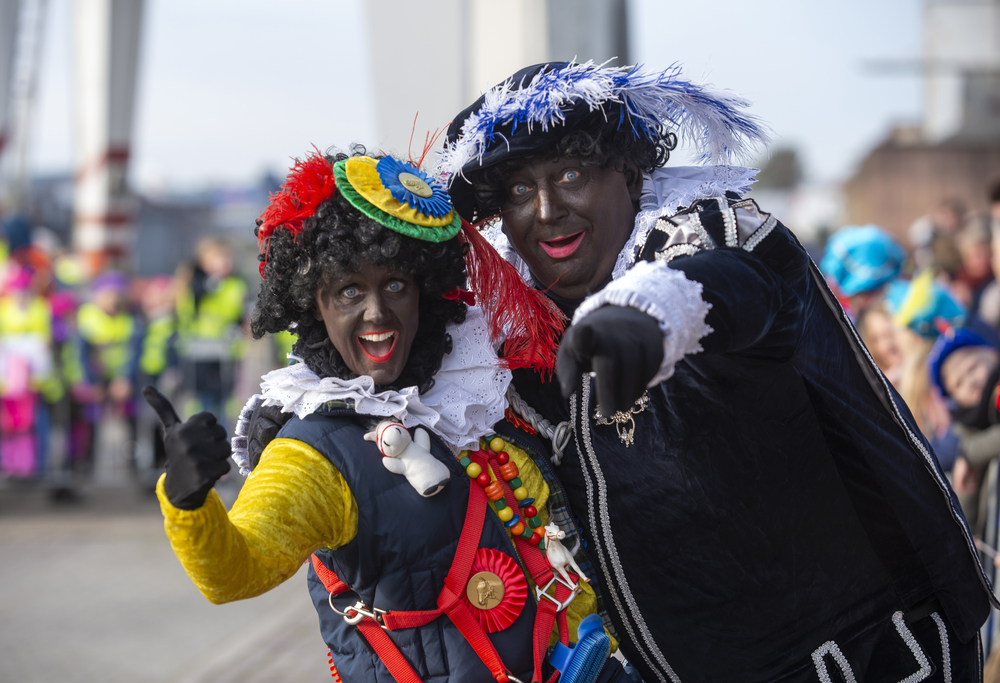
Some Dutch disagree with allegations of racism because, for generations, they’ve viewed the festivities as something entirely wholesome to bring joy to children. How can others accuse them of racism when they’ve never knowingly had racist intentions?
The Sint en Pietengilde, an organisation fighting to preserve the traditional Zwarte Piet, says that supporters are “generally surprised” when they notice that people see Zwarte Piet as a racist figure.
From the guild’s perspective, “This is still often not recognised. As a result, acceptable ways of depicting Zwarte Piet from history are incorrectly interpreted as racist.”
The majority of these blackface supporters are in disbelief that Zwarte Piet is discriminatory, and they feel misunderstood.
The main arguments that the Zwarte Piet traditionalists make are that the character has been misinterpreted and others have overreacted, while they simply want to continue with their traditions in peace.
Anti-Zwarte Piet: the no-blackface argument
People opposed to Zwarte Piet emphasise that the character’s cartoonish, historically unsavoury portrayal reinforces negative stereotypes, contributing to an inherent bias against people of colour. They see some issues that need resolving before the holiday can be a peaceful one.
For Zwarte Piet’s opponents, historical evidence proves the character arose out of colonial times when slavery was the accepted norm.
They say that this bias against black people has been carried with Zwarte Piet over the years, whether consciously or not. They see the blackface character as a racist and harmful relic from the past.
The anti-Zwarte Piet camp also doesn’t generally buy into the idea that black paint was separate from the popular and embarrassing blackface makeup of the time.
Blackface was used by white people as a device to mock and dehumanise Black people in their portrayal, not only in the US but also throughout Europe.
But aside from addressing Zwarte Piet’s problematic history, opponents want to shift the focus toward a future of equality. They argue that continuing to reinforce negative racial stereotypes creates an unconscious bias in society, keeping people of colour at a disadvantage.
Even beyond the aim for broad societal change, Zwarte Piet’s opponents want an end to the everyday racism that the character encourages.
READ MORE | Child calls another child “Zwarte Piet” because of his skin colour
Many black people in the Netherlands have had experiences where they’ve been referred to as Zwarte Piet in a derogatory way, often as children. Some have also encountered more aggression and other racial slurs, particularly around Sinterklaas.
As Jerry Afriye, leader of the action group Kick Out Zwarte Piet says, “By the same adults who now shout from the rooftops that Zwarte Piet is not racist, you can be called Zwarte Piet.“
“For example, in the workplace, ‘There you have our Zwarte Piet’. Or on social media, as a caption to a photo of Mandela: ‘[The Head Piet] is dead’.”
Lost in translation?
Where the conversation often gets stuck is on the very words “racist” and “racism”. Racism is thought to be exclusive to more overt racial aggressions.
Everyday bias and systemic racism are still relatively foreign ideas in the Netherlands. Getting on the same page about what is and isn’t racism is a hurdle in itself.
What’s more, racism has not been largely discussed in the Netherlands until recently and is a bit of a taboo topic. It doesn’t fit with the Dutch cultural identity, so the jarring word “racism” stirs immediate discomfort and defensiveness.
There’s a big disconnect in the discussion when it comes to behaviour that many do not recognize as discriminatory because it’s based on tradition, while others experience that behaviour as hurtful or insulting.
Momentous reactions to Zwarte Piet
Zwarte Piet has had many big moments in the media over the past century or so. This timeline covers some of the most influential:
In recent years
Over the last several years, Zwarte Piet has had too many spotlight moments for this humble timeline. In 2018, the action group Kick Out Zwarte Piet organised protests that made big waves in 17 Dutch cities.
Because of all of the commotion in recent years, several cities have banned the Sinterklaas entry altogether, while others will allow it only with modified Pieten. In 2020, the coronavirus took care of cancelling them all.
An ever-growing number of stores in the Netherlands have stopped selling merchandise with the Zwarte Piet image. The popular HEMA, Jumbo, and Bol.com have all said goodbye to blackface.
On social media, Facebook and Instagram have also banned images of Zwarte Piet from their platforms. Even Amazon and Google have recently taken a stand. Libraries, too, have removed books depicting Zwarte Piet’s image.
In 2020, the Black Lives Matter protests and international antiracism movement sparked by the murder of George Floyd, called attention to systemic racism in the Netherlands.
As a result, the voices standing up to racism are louder than before, and conversations about it are becoming more normalised.

But the voices of white supremacy are also increasing. Some anti-Piet activists have been the targets of hate crimes, threats, and violence. Jerry Afriye of Kick Out Zwarte Piet received a letter earlier this year that read, “…we will have fun slaughtering you, your family, and extended family…and won’t wait for Sinterklaas.”
Acknowledging systemic racism
In 2020, this new focus on race pushed Prime Minister Mark Rutte to acknowledge for the first time that there is institutional racism in the country.
He also said that he had changed his opinion of Zwarte Piet after realising that children were feeling discriminated against during the holiday festivities. “That’s the last thing we want during Sinterklaas,” he said during a press conference.
Rutte didn’t feel the government should step in. He predicted that in a few years, “you will hardly see any more Zwarte Pieten.”
This was particularly big news because, in the past, even Mark Rutte has worn blackface in Sinterklaas celebrations. So have many of the lovely, good-hearted Dutch people you may know.
This is perhaps why the shift toward seeing the character as a racist symbol has been met with such resistance — how could this whole culture that is widely thought to stand for tolerance and inclusion be racist?
Well, it’s a bit more nuanced than that, and people are starting to recognise it.
A shifting paradigm
Over the years, we can mark a clear shift in the Netherlands’ perception of the holiday character. It was slow and steady at first and then exponential over the past year.
More and more, the Dutch are opening up to the idea of eliminating or modifying the character to be more sensitive to racial stereotyping.
Sooty Piet & Chimney Piet
To find some middle ground, some municipalities have suggested different colours of Pieten as an alternative to the blackface character. Red, blue, rainbow, and even the contentious grey, but none as promising as the Sooty Piet (Roetveegpiet) or Chimney Piet (Schoorsteen Piet).
This rendition of the character has soot smudged on his cheeks to support the newer adaptation of the story, which claims that Piet’s face is only blackened from the chimney.
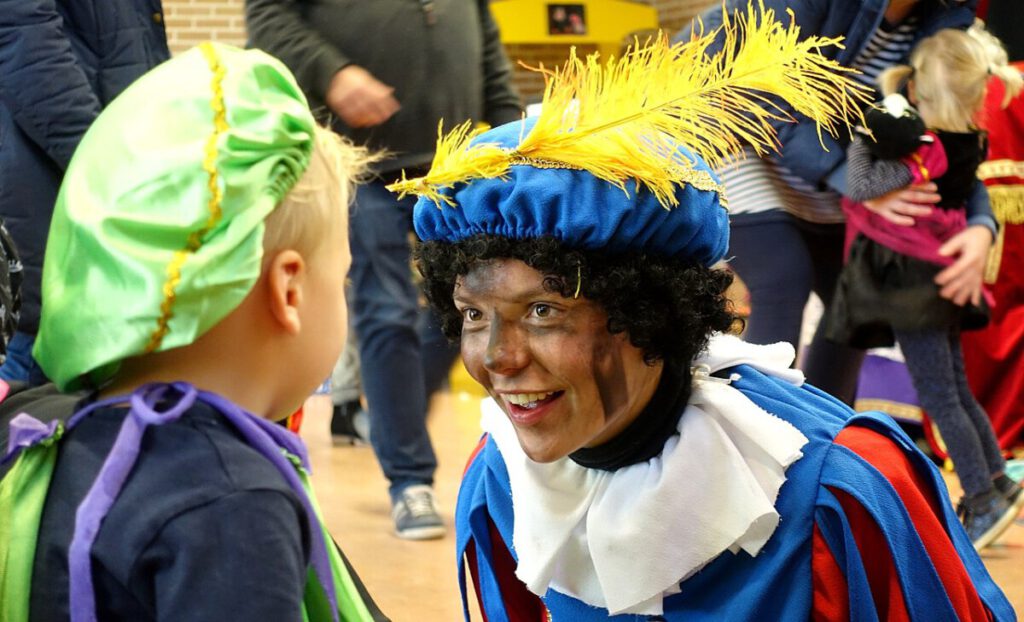
This new narrative is, of course, a modern workaround to the blackface issue. While many still do not approve, others, including the Zwarte Piet action groups, are more comfortable with it than the original.
Public opinion about Zwarte Piet
Since 2013, Dutch news outlet EenVandaag has been hosting an annual “Opinion Panel” regarding Zwarte Piet. The survey shows whether people view the character as discriminatory and whether or not his traditional appearance should change.
It’s clear that a growing number of Dutch people are coming to the conclusion that traditional Zwarte Piet is problematic.
They wanted to see if the movement had influenced opinions of racism in the Netherlands — it had.
READ NEXT | 7 things the Dutch don’t talk about, but should
In 2020, far more Dutch people say that Zwarte Piet should change, and fewer people say the character should stay the same.
The November 2020 survey shows many of the opinions from June have been upheld, while a smaller percentage was likely a temporary product of the social movement.
It should be noted, however, that most people who changed their minds in 2020 indicated on the survey that they are in favour of adjusting Zwarte Piet “to keep the peace” rather than because of a changed perception of the character. They want to “get rid of the social unrest and demonstrations.”
In 2021, survey results were similar to those of 2020, with 56% saying they did not want to change the appearance of the character and 32% saying it should change. However, 46% of people saw Sooty Piets as a reasonable alternative.
Talking about racism
While the data shows signs of change in Zwarte Piet’s future, the debate will likely be around for years to come — there is still much to be discussed. EenVandaag’s survey in 2020 also asked, “Do you have the feeling that you can say in public in the Netherlands what you think of the appearance of Zwarte Piet?” Only 45% of the Dutch (known for their directness) replied yes.
Whether or not people are willing to talk about their views openly, the whispers behind closed doors show there is still convincing to be done.
@dutchreview Awkward… 😀 #MemeCut #expatsinthenetherlands #dutchreview #voorjou #fyp #dutchtiktok #Meme #zwartepiet #controversial #netherlands #expatlife ♬ original sound – Slozicemosedaseslazemo
Action group Nederland Wordt Beter says a future that is more inclusive and without racism “can only be achieved by recognizing the influence that the colonial and slavery past has on today’s society and on all Dutch people.”
It’s fair to say that Zwarte Piet is a big part of that conversation, but he’s certainly not the end of it.
That’s why one of the guidelines Nederland Wordt Beter is pushing for, along with the changing of Zwarte Piet’s appearance, is education about why it needs to change — “to turn anger into understanding and solidarity.” Because, of course, to keep the peace, you first have to find it.
Have your say
How do you find the Zwarte Piet debate? Do you think the character’s appearance should change? Tell us your thoughts in the comments below.

When the tradition started there was barely a black person to be found in the Netherlands. Times gave changed. Time to move on.
The tradition isn’t meant to be racist, but i can see how it’s problematical for some people. Changing it isn’t such a problem, and it has allready changed. Which is fine.
In the former colonies piet was until recently also played by black actors in black facepaint.
I know several black Dutch people in the Netherlands that also used played piet in darker facepaint in the 90s and 00s. They didn’t see it as racist. And some of them still don’t.
The problem is people viewing traditions of other cultures through the eyes of their own (problematic) cultural background.
In both ways.
And that’s where the backlash comes from.
The Dutch have a historical problem of other cultures pushing their opinions and views on them and telling them what to believe.
Just ask the French and the Spanish.
Changing sinterklaas traditions is also part of Dutch tradition. In 1965 Sinterklaas allready threw the sack and rod overboard on national television, because he thought they were outdated. He loves children and gives them gifts. He doesn’t punish them was what he said. (Adri van Oorschot)
In the film ‘Bennie stout’ sinterklaas (bram van der vlught( made a similar statement.
It took most Dutch parents some years to confirm that.
They’ll get used to sooth pete…
And them someone from a different culture will find something else that offends them.
And we will eventually change.
Zwarte Piet isn’t the American blackface. He has it’s roots going back to ancient pan-European pagan traditions. So please stop Americanizing, and thereby racializing European traditions, because those are absolutely not the same.
I like to see it changed yesterday but ‘blackface’ is an English word that has no Dutch translation because mocking blacks by painting faces is an American and English tradition, yes, England is in Europe too but anglo culture and it’s racism isn’t universal.
Slavery wasn’t the norm in 1850 when the abolitionist Schenkman introduced the character of Zwarte Piet. The Kingdom of the Netherlands had abolished the slavetrade in it’s first year of existence, 1815, and politicians were bickering about how to end slavery for the remaining 6000 slaves.
It’s the Americans and English that put the racial hatred into facepainting, and what has been seen can’t be unseen so that’s forcing the Dutch to change an innocent tradition many blacks have participated in in the Netherlands since the 70’s but also in the former Dutch colonies. Because it’s fun and it makes for an effective disguise which is required. So the Americans should apologize to the Dutch for spoiling facepainting for the rest of the world.
Instead we have Americans not even 2 years in the country and probably not capable of reading Dutch yet explaining how it is and projecting American racism onto the Dutch and subsequently lecturing them on it. Imperialism anyone? We’ve been discussing American racism for ages and you were always the most backward one of the West togehter with South-Africa, and are still very much behind. Maybe someone from Saudi-Arabia can come live here for a year and lecture us on women’s rights?
It truly is a pervasive mindset here in the U.S. where politics and media view, report, and interpret everything in terms of race and discrimination. From weddings, scientist’s achievements, celebrity successes, deaths, retirements, candidates for positions, political appointments, corporate executives, and so on, if a famous person has a speck of minority ancestry, that minority is emphasized and all others are excluded. They think perhaps they are being complimentary to the minorities, perhaps they feel righteous, but to me it smacks of condescension.
Zwarte Piet can be considered racist, but only if he’s portrayed as dumb, exhibits clownesk behaviour, and has a speech impediment. Or when it’s a Surinam caricature; brown face, Surinam accent. Golden earrings are also not ok and not needed.
A 2021 Zwarte Piet however, a person wearing colourful clothes and with a face painted black, handing out gifts and candy to childeren, not acting dumb, is not racist.
In fact, the opposite is true. Whitewashing Zwarte Piet is racist, and gives children the signal that there is something wrong with black skin colour.
My first encounter with Zwarte Piet was in the fall/winter of 2010 when I was studying abroad in Groningen. Whenever I was told Zwarte Piet’s face was black due to coming in the chimney, I would always ask why his clothes remained clean then? I never received an answer to that question. Sure why the afro, big red lips, etc is also a legitimate question, but what kind of magic soot clings to skin but not clothes?
The tradition was meant for very young kids. They never came with those questions and most important they never even thought it had to do with racism.
Zwarte Piet is the coolest Persona in The Netherlands. He neither racist or offensive.I Love Zwarte Piet.
Black is the lucky colour. Piet is a positive pagan figure.
Ja zwart is goed geluk! Black is beautiful and labels are powerful. Thanks for the positive comment. .
This is not a ‘full guide’. You don’t know anything about the folklore behind Sint & Piet. Try to inform yourself before you write such a pretentious piece. And by the way in Ghana, the country of origin of the Dutch anti-Piet activists, people use white-face during their own folklore. So it’s the pot calling the kettle …
OMG At least check your statistics before presenting a graph. The image shows that more and more people want Zwarte Piet to stay the same and less and less people want him to change. Obviously you got things mixed up. I am surprised the editors or reader for that matter did not even see this…🙈
For the rest, I think it is a great article showing both sides without trying to be judgemental / taking a stance.
So many racist apologists here. Wow. It’s more than about the blackface… the crude representation of Black African facial features, the afro wig… inorm yourselves instead of being defensive.
“DeNa”you refer to African facial features and Afro hair as if those are bad in some way. I guess that makes yours a racist comment. It is a slippery slope is it not? Can’t we all just be nice to each other?
There is no prosthetic make up.
Really DeNa, you call people racist apologists? Defenisve? Just because they don’t agree with your opinion? So cheap and ignorant.
If painting one’s face black pains people who are naturally black, then common courtesy dictates not to do it. Just as simple and uncomplicated as common decency.
I read the article hoping for deeper insight into the custom but I’m still wondering how it all evolved. Is there any historical basis for the evil Bishop depicted in the movie “Sint” ? Truth or fiction, the movie presents explanations consistent with a time when the church had the power of government and people could be, and were, burned for heresy, heresy being whatever offended church officials.
Zwarte Piet in the Netherlands is like Zwarte Piet in Belgium, Schwarze Peter in German speaking countries. He also appears in (former) parts of the kingdom overseas. Only in the Netherlands (EU) there is this discussies, in other countries him being black is still undiscussed.
Yes Origin can be linked to slavery.
Yes Role changed several times through time.
Yes It can also be linked to racism.
No ZP never made me look in another way to my fellow countryman of colour.
One could argue that whether or not ZP is a racist “item” to the Sinterklaas tradition is dependable of the person himself. I know people of colour who have no problem at all with ZP and I know people of colour who find ZP offensive. My personal opinion is that in the home context you need to give context to ZP and then ZP can be black, yellow or purple.
Good article and good comments.
I like to add that the Swiss guards who protect the Vatican are dressed like zwarte pieten. Sinterklaas as a saint is likely to have Swiss guards protectors, not slaves. Maybe there is a slave subtext. Maybe not. My point would be that the contemporary use of zwarte piet does not have to be connected to slavery at. However it is understandable that some people view it that way. The question than becomes who should change their views. In my opinion the nondiscrimatory nonslave interpretation is correct.
You are an immigrant. If you didnt grow up in Netherlands you will never understand. Only foreigners can come up with a long article thats 80% about the racist point of view. For your missing info: Dutch people had no problems when years ago your “ earribgs, thick lips and curly afro wigs’ were taken away from the official Black Piet. And Zwarte Piet in Dutch slur can mean being the unlucky one totaly unrelated to the festive Zwarte Piet.
I must express my disappointment in Dutch Review for posting such a disinformational, inciting and downright offensive piece about one of my country’s oldest traditions.
For starters, there is no such thing as BLACK PETE. The NAME is Zwarte Piet. Black Pete is a deliberate mistranslation aimed to offend holier-than-thou people from the US who are triggered by the word black. If you have to be so xenophobic that you just have to translate foreign names into your own limited worldview, than A) the more proper translation would be Suarthy Pete and B) you’re welcome to stay home, because you’re not up to the challenges of a multicultural outside world.
BLACKFACING is an American (US) concept that has no counterpart in Europe. The same people who complain about blackfacing will complain about WHITE WASHING if Europeans did not apply face paint when portraying individuals with other skin colours.
Did Europeans historically apply face paint when portraying individuals who are NOT HUMAN? Yes, and they still do.
Why black? Because black is NOT A NATURAL SKIN TONE.
The appropriation of BLACK CULTURE is not a thing in Europe because there is no such thing as ‘black culture’. People are not culturally bound to their skin tone. And Africa is a pretty big continent, with way more than just one culture (or colour). Black culture is, again, a US concept that is only appliccable (and I suspect predominantly in the minds of ‘white Americans’) to the cultural divergence of former negroe slaves and their offspring, which were mostly borrowed from their former masters, with no more than a distant echo from African pasts. Even ‘black music’ is an offshoot of ‘white music’, with some African rythms thrown in, the product of seggregation as much as cultural evolution and it should just be called ‘USA culture’.
So neither the concept of blackface nor the word applies here.
WHO IS ZWARTE PIET?
The name Zwarte Piet is as old (or new) as his current incarnation, from the latter part of the 19th C, so one and half century old. That’s nothing on this side of the pond. The name roughly translates as boguey man, which is also encountered outside the Sinterklaas tradition, in sayings like ‘Hij is/speelt nu even de Zwarte Piet’, meaning it’s up to him to bring bad tidings and enforce impopular decisions; ‘Iemand de Zwarte Piet toespelen’, to pass the buck/blame to someone, probably derived of the card game ‘Zwarte Pieten’, ‘Black Jack’, as in the Jack of Spades (not the game black jack).
Historians who have looked into the past of Zwarte Piet, for the most part haven’t. That is to say, since the name of Zwarte Piet is entirely modern, they used another identifier and looked for iterations of the ‘knecht van Sinterklaas’, which only goes back to the start of the Sinterklaasfeest, at which point the figure of ‘Zwarte Piet’ already existed. AFAIK only one journalist took the wider view and investigated outside of the Low Countries. (Saint Nicholas is celebrated throughout the Low Countries, which include Belgium and parts of Germany and France.)
It is at this point that I have to say that although I myself have seen no evidence of this, it is entirely possible that the Sinterklaasfeest including Zwarte Piet was imported to the Low Countries from somewhere else.
Figures like Zwarte Piet are found throughout the TEMPERATE ZONES of Eurasia. This is important, because if you’re from warmer climates, you may not recognise this without pointers, but the Dark Ones, be they called Zwarte Piet or Krampus or what have you, herald the Dark Season (Autumn and Winter) and their congregation symbolises the gathering dark, and the storms, the cold and the hunger associated with that. They often reward the good an punish the bad. Not the evil, that is the later Christian interpretation. Good was diligence and reliability, bad was laziness and irresponsibility. If you had been good, that meant you had done your chores, maintained the house and stables, stockpiled food, fodder and firewood (fuel), your animals were healthy, your crops had been harvested and your fields were well cared for. You would make it through the winter and people could rely on you. If you had been shirking your chores, the roof would blow of your house, food and fodder would rot in your cellars, your animals would fall sick or starve, the fertile topsoil would wash of your fields and your people would seek shelter with someone else. Your best scenario would be to become a free servant to someone else, but you would not have your own farm again, because clearly you could not be trusted to take care of your own affairs.
At least, that would have been the message. They are also usually accompanied by a Wise Old One. Now the Wise Old One is not their master, not their leader, nor even one of them. But he is untouchable, because he’s wise and has his affairs in order. And he has survived many, many winters and that’s how he became old. Where Zwarte Piet is the warning, the Wise Old One is the shining, but stern, example.
So it’s not about slavery, it’s not about chimneys, it’s simply about seasons.
SO SINTERKLAAS IS NOT ABOUT DISCRIMINATION?
Hell yeah, he is. Sint Heer Klaas is all about discrimination. The first notable corruption of the happening of the Dark Ones is the subjugation (knechting) of indigenous pre-Christian proto-pagan seasonal observances and adherences by a Middle Eastern intolerant monotheistic single party murdering, burning and pillaging doctrine known as the catholic church, by replacing the Wise Old One with a Christian Saint. Things have gone downhill from there, replacing simple agrarian common sense by infringing ideologies. Sinterklaas is about discrimination of the Old Believers. But Zwarte Piet isn’t.
SO ZWARTE PIET HAS NOTHING TO DO WITH SLAVERY?
Originally, no. In his current incarnation, no. In between, yes but probably not as you expect. And here we come to Jan Schenkman, about whom many theories have been spread. Let’s try and keep this simple. Prior to Schenkman, the Dark Ones number had been limited to one (because they couldn’t be allowed to outnumber the saint) and shaped into incarnations like Knecht Ruprecht or the Leutenfresser, devilish creatures that put naughty children in a big bag, to be taken to their lair (hell) and eaten. When talking about Schenkman it is important to remember that regardless of whether he was or wasn’t a ‘kindervriend’, he was born in 1810! Six years before a combined Anglo-Dutch fleet finally put an end to the Barbary corsairs who had been raiding the Mediterranean and the Atlantic since the 16th C, taking many prisoners and selling them as slaves on the markets in North Africa. They raided and evacuated entire villages, primarily in Spain (!), but also in Italy, Southern France, the Western Islands and on the Atlantic as far North as Ireland. Schenkman did not reimagine the ‘knecht van Sinterklaas’ as a negro, nor in colourful clothes¹, both those statements are false. Schenkman reimagined the Christian idea of a child eating demon as the closest thing he knew, the most fearsome figure from his own childhood, a Moorish sailor who would rob children from their own homes and villages and take them to the hellish slavepits across from Spain.
After Schenkman (who died before the Barbary slavetrade was officially ended in the late 19th C.) the image of the knecht shifted from Moorish sailor to negro page, and started the 20th Century with the name Zwarte Piet. After 1820 the moorish page, in colourful clothing became popular at European courts. It could be in celebration of the ‘knechting’ of the Barbary pirates, or simply in celebration of peace. Who could say.
Although the verb knechten is used in the meaning of subjugation, a knecht is not a _lowly_ servant. It is the highest station a commoner can achieve in someone else’s employment. A huisknecht (house knecht, i.e. a butler) is not just a man-servant, but a ‘gentleman’s gentleman’ and chief of the household staff; a boerenknecht (farmer’s knecht) had his own room (usually in the stables, which were warmed by the animals) and ate his meals at the farmer’s table, while the hands slept and ate in the hay barn; and a meesterknecht (master knecht) ran a factory (usually supervised by a well born gentleman who didn’t get his hands dirty). Knecht is also the root for the English word knight. This is a thing to remember in an age where precious few people are self employed.
There is no inherent racism in the Netherlands. I’m not saying there is no racism, and far be it from me to make assumptions as to how wide it spreads, but unlike the USA, with their segregation laws and tactics that are still not completely abolished, racism is not systemic in the Netherlands.
I’m also not impressed with the claim of ‘solid historical evidence’ when the little historical evidence that does exist is blatantly misrepresented by the article. Historical evidence that Zwarte Piet rose from slavery simply does not exist. Historians agreeing that black pages were slaves because they weren’t paid? PAGES WEREN’T PAID. Call it child labour if you want. Slave trade had been abolished in 1814, slavery in overseas territiries was abolished in 1860 and 1863 (at which time most slaves on Curaçao had already bought themselves free) and slavery within the Netherlands DID NOT EXIST. Who are these agreeing historians? The people in Europe, with the exception of a few merchant crews and hundreds if not thousands of sailors who had been thrown into Algerian slavepits had no exposure to slavery and slaves. They weren’t waited on hand and foot by people of different skin colours. Poor seasonal contractors came from Germany, not Swasiland. And the country still had people living in sod houses working for wages below subsistence level.
Oh, and ‘people of colour’ is a racist term. What you’re saying is ‘non-white’, as if people’s racial identity is dependant on whether or not they’re white. Neger and blanke are descriptors, people of colour is an exemptor. Do also bear in mind (warn your readers) that all of these words do not translate well into Netherlandish. Zwarte (black) and witte (white) are deemed extremely offensive as these are the actual derogatory terms when we do use them. And kleurling (‘colourling’/person of colour) is an avoidable word for a person of mixed heritage.
DO I THINK THE ZWARTE PIET IMAGE IS WRONG AND SHOULD ANYTHING BE DONE ABOUT IT?
I do. It’s a caricature that has nothing to do with the origin of the Dark Ones, nor even with Schenkman’s reinterpretation. I don’t know where it came from. I guess the illustrators who made those drawings after Schenkman had invented the Sinterklaas-genre didn’t really know what a Moor or a negro looked like, or deliberately steered away from something identifiable. It’s a bit like the gaper (a traditional sign for an apotheckary) that was designed by a modern ‘artist’ for a new apothecary, that had to be removed because people took offense. Those people were right. That was not a traditional gaper, which is a work of art that pays hommage to the fact that medicines are in part based on knowledge gained from Arabian and North-African countries². That was a grotesque caricature.
What I do know is that the image of Sint and Piet is influenced by accessibility. The Clown’s wig (F you for calling it an afro) is new and also extremely cheap and easy to keep, since the hairs do not tangle. They are sold in all colours and the most popular is actually the orange one. Before these hit the shops people would hide their hair, or simply went with what they had, especially if they had dark hair themselves. In a time when people could barely afford presents, everyone had shoe polish, both black and brown, and all women had lipstick (because you don’t want shoe polish on your mucous membranes), and often loop earings, that they used to replace the gold sailor’s earring (which is a thing). There were few things affordable in the post war years in Europe, but Sint & Piet were, and people went for it, and the next generation followed that example. That is where all the good memories come from. Tread on that and people will rightfully take offense.
The attack on European indigenous culture no matter how disguised as politically correct indignance (and it’s not like the lies and bias weren’t dripping of my screen while I read your article) is based on lies, and I can tell you which. This all started when writer/poet Boudewijn Büch during an interview explained the Sinterklaasfeest to a – excusez le mot – black American actor who’s name I forget as ‘The Saint and his slaves’. Büch was a compulsive liar who enjoyed riling people up. If you ever find that interview, watch the expression on his face while he watches the actor react.
As for Sinterklaas, I have no need to mount a Christian supremacist on an ancient tradition, no matter how many Germanic cultural elements he appropriates. As far as I’m concerned both Klaas and Claus (who is even worse) can be replaced by Budai, who meets the requirements and is actually bigger than both of them combined. Although probably almost no-one outside of Asia would know who he is.
But Zwarte Piet must stay, though not necessarily by that name and certainly not in that silly outfit.
¹) In fact, in Schenkman’s own illustration, the sailor’s outfit looks very (Southern) European
²) Although the ‘Moriaan’ is the most recognisable not all are depictions of North African men. But they are almost all authority figures of some sort.
Although I agree with some of Edwin Hofstra’s points, I find it more than a bit ironic that on the one hand quite a few people on here rile against someone ‘from the US’ commenting on a tradition from the Netherlands and Flanders that’s nothing to do with them and that they don’t understand, while at the same time being virtually obsessed with ‘US culture’ and enthusiastically adopting halloween, coca-cola santa, black Friday and a lot of other US influences (is thanks giving next?), including interspersing their native Dutch with often so many (US) English words, often inappropriately, when a perfectly Dutch word is available, that it resembles some kind of ‘broken Dutch’. In general, I’m not against adopting sooty Piet, similar to the Swiss schmutzli. It’s not really the end of the world and people will get used to it. As is mentioned on here, Zwarte Piet has been evolving as well, so this could be one of those things that’s more in tune with a multicultural world (which is reality, whether you like it or not…).